Surprise! If you have read anything on this blog, the signs are there.
But what is it? And why does it matter to me as an adult?
It turns out, alot. Let me explain.
The DSM (Diagnostic Statistical Manual) defines ADHD as:
- Failure to give close attention to details
- Trouble holding attention on tasks
- Does not seem to listen
- Does not follow through on instructions
- Has trouble organizing tasks
- Avoids tasks that require mental effort over a long period of time.
- Is often forgetful on daily activities.
- Often interrupts
- Is impulsive
Pulling back the layer of the onion, it is an ambiguous diagnosis with a spectrum of traits. We are the people who don’t pay attention at meetings, but come out of nowhere with a fresh idea to save the day. If you were to climb inside my brain, you would see ideas popping around like popcorn kernals. My mind is here, there an everywhere. Often I can offend people by not remembering their names, but make good on it by understanding what nobody else has picked up on.
We like irrational. We’re at home with uncertainty. We’re at ease where others are anxious. We’re relaxed not knowing where we are or what direction we’re headed in.
There are paradoxes too:
- Trouble organizing and planning. Also Called “executive functioning”. However, we can also create doubt by giving an amazing presentation on time, hyperfocus, and be super-reliable when interested.
- High degree of creativity and imagination. This can be snuffed out by years of criticism, lack of appreciation.
- Trouble with time management, and a tendency to procrastinate. We experience time differently. In our world, there is “now” and “not now”.
- Strong willed, refusal to accept help.
- Unique sense of humor. Quirky, off beat. Many stand-up comics are ADHD. They think outside the box.
- Gruff, awkward, rude, unfiltered, or aloof. This is the part of “impulse control” that those of us with the diagnosis suffer with.
- EXQUISITE SENSITIVITY TO CRITICISM. William Dodson, one of the most accomplished doctors in ADHD, coined the term “Rejection sensitivity dysphoria”, describing tendency to overreact disasterously to even the slightest perceived put down, dis, or vaguely negative remark. On the flip side, we have an enhanced ability to make use of praise, affirmation, and encouragement.
- Impulsive and impatient. We make quick decisions, have trouble with delayed gratification.
- Uncanny accurate intuition. And a tendency to overlook the obvious.
- Transparency to the point of being honest to a fault. We are often tactless, and politically incorrect, heedless of repercussions and consequences.
- Tendency to externaliz or blame others while not seeing your rold in the problem. Coupled with the inability to observe oneself accurately.
- Distorted negative self-image. People with ADHD have a self-image that is more negative than warranted. The phrase “attention-deficit-distorter” has been used, because of how it distorts so many perceptions of reality. While on the other hand, creativity depends on the ability to “distort” the ordinary.
The science behind it.
There is a part of the brain that is active when a person is engaged in a task. This is the part of the brain that lights up and shows activity in the neurons when a person is writing an email, making breakfast, or reading a book. In this state, you do not think about being happy or unhappy- you aren’t wasting time in self-assessment. If you use the image of an angel on one shoulder and demon on the other, this is the “angel” mindset. We can get trapped here- doing a task with the inability to disengage. This is the hyper-focused part. The brain is a muscle, and if less time is spent here being focused, this part of the muscle atrophies.
If not focused on a task, another part of the brain gets engaged, called the default mode network. This is the part of the brain with creativity, imagnation. It is also part of the autobiography, memory, and personal history, allowing us to think back, draw upon, and pick apart the past. The same part of the brain helps one to look forward, imagine, and plan for the future. It is this part of the brain that allows us to daydream (and miss the exit on the highway).
These two parts of the brain are the ying and the yang of the brain. People with ADHD have a broken “switch” between these two states. And people with ADHD are especially prone to head toward gloom and doom in their minds because they have stored up in their memories a lifetime of moments of failure, disappointment, shame, frustration, defeat, and embarrassment. This can cause us to abandon projects that were started with enthusiasm, make careless errors, or fall into a state of misery or despair for no good reason.
Many of the lines above are direct quotes from this book, and I encourage you to read it. Here is the link on amazon.
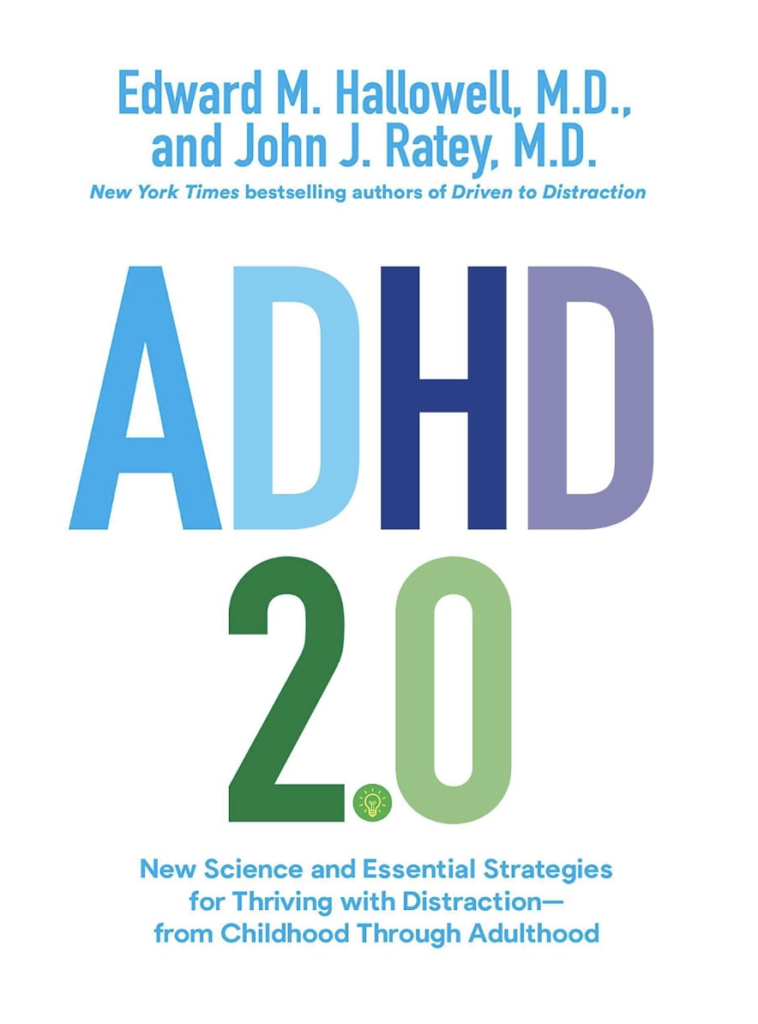
What it means for my life.
The attention parts listed above I understand. I was diagnosed 10 years ago, and never thought much about it. But recently I got curious- besides medication, what can be done about the things listed above? It turns out, just identifying the umbrella of definitions above has been tremendously helpful. Yes, ADHD controls the ability to pay attention to a task at work, but who knew that it also applied to the way I thought about myself, the parts of creativity in life, my occasional sad spirit, and politically incorrect texting?
Being aware of it is a huge first step. The book goes on and has tremendously helpful insights. Knowing that “there are good days and bad days” helps me feel better about things. I know that some days are easier to bang out tasks and be productive than others- I just never knew I was alone in this.
I’m doing better than most. What I didn’t include in the list above is the tendency for people with ADHD to get addicted to drugs, be reckless with relationships, and irresponsible with money, binge eat. These don’t seem to be issues I struggle with- even though I have been known to eat a bag of Doritoes in the past.
The most important thing is that I married Taylor. She is the mirror I can rely on, a steady rudder to keep moving in the right direction. When my attention wanders, she can keep me on track. If I am down on myself, she is kind. If I have any relationships at all, it is because she has room to spare. Though I can’t juggle all the home duties and kids responsibilities, she does it with grace. If I am over analyzing, she will keep things grounded. When I am impatient and overreact (as a parent), she will keep me in check. Somehow, I think even before I realized it, she had the parts I needed to be complete as a person, and I am grateful for that always.
Also understanding the connection between exercise and ADHD mental health is huge. The book encourages us to “think of exercise as taking medicine”. Not for the goal of losing weight, but for the goal of knowing how good I feel afterwards.
And the connection between healthy foods (and specific foods) and mental health is huge. Yes, certain food do help me stay focused, feel more optimistic, and leave me feeling great for the day.
To be quite honest and transparent, I am not sure everything this means for me and my life. But if there is a moment when I feel down, or if I am over analyzing a situation or a slighted comment, it feels good to know that I am not alone. There are so many situations and areas of life that I hope to understand better now.
Leave a Reply